



Gold Baby Bracelet with Engraving: Buying and Care Guide
More than 677,000 children are born in Germany every year, which is why a gold baby bracelet with an engraving is one of the strongest personalised gift ideas for a birth. It is especially suitable when you want to give not just an ordinary accessory, but a lasting keepsake with a name, date of birth, or time of birth.
You may be standing in front of a gift box right now, wondering what would truly be appropriate for a newborn. Clothes become too small, toys get replaced, and many well-intentioned gifts disappear into everyday life after a short time. An engraved gold bracelet is different because it captures a specific moment and can later become part of the family story.
My clear recommendation nevertheless is: Buy such a bracelet as a high-quality keepsake, not as unsupervised everyday jewellery for a baby. The material, clasp, engraving, and intended use must all be compatible. Anyone who checks these points is not only giving something beautiful but also demonstrating responsibility.
Table of contents
- Choosing the Perfect Keepsake
- Understanding materials and solid gold versus gold plating
- Safety aspects and child-friendly design
- Engraving options and personalization
- Care and durability of gold jewelry
- Conclusion and why an engraved gold bracelet lasts
Choosing the Perfect Keepsake
The search often begins with a simple but emotional question: What can I give as a birth gift that will remain personal? Grandparents, godparents, and close relatives want to make their connection visible without overriding the parents' taste. A gold baby bracelet with an engraving offers a clear solution. The child's name makes the jewellery unique, while the precious metal honours the occasion.
Despite declining birth rates, Germany remains a major occasion market. In 2024, 677,117 children were born alive, which was 15,872 births, or 2%, fewer than in 2023, when 692,989 newborns were recorded, as reported by Destatis on births in Germany. However, every birth represents several possible gift decisions. Parents, grandparents, godparents, and other family members can each choose their own keepsake.
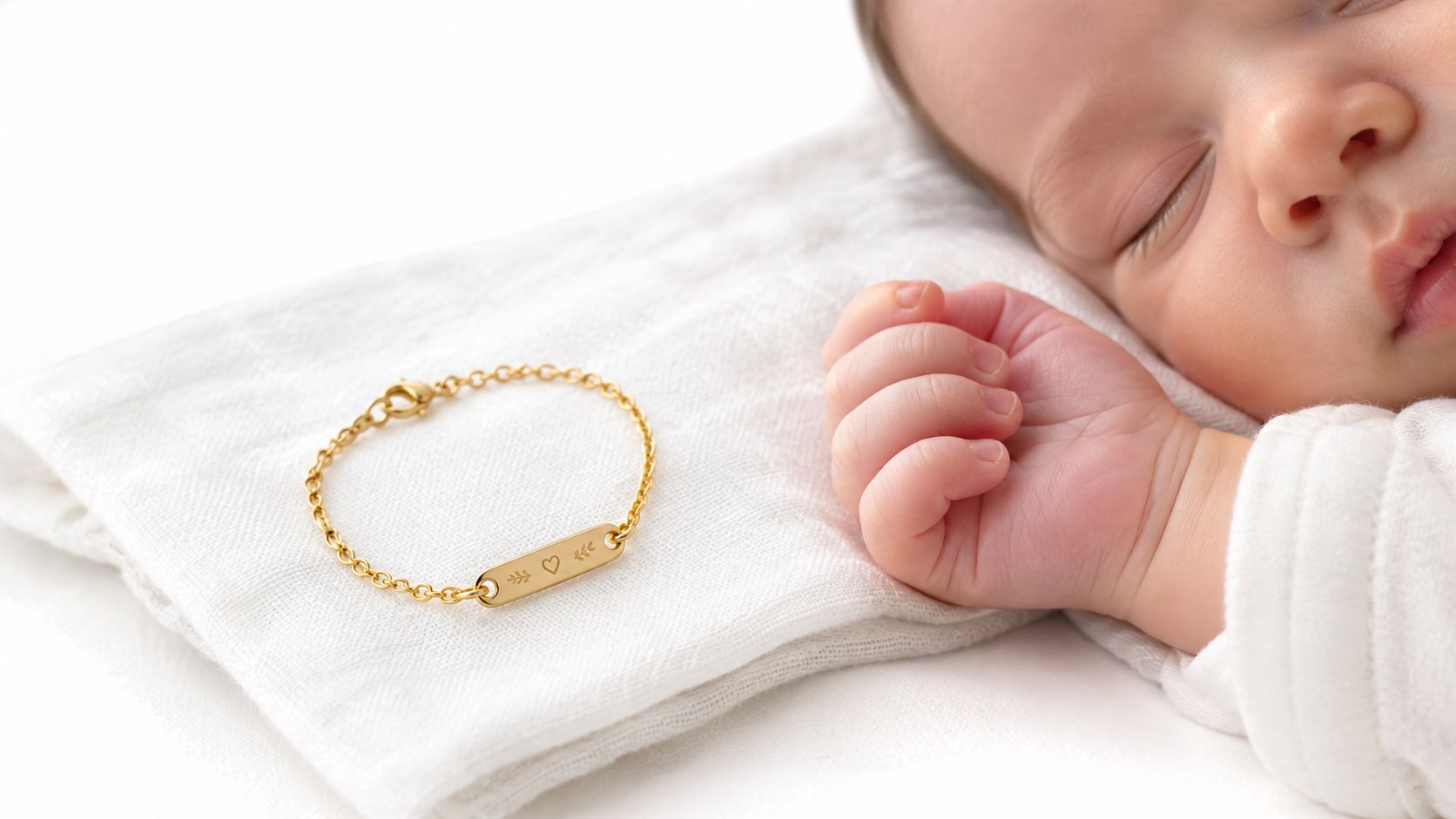
Why Gold Is More Than Decoration
A birth gift has a different purpose than a fashion accessory. It is meant to preserve a name, a date, and the memory of the new addition to the family. A simple bracelet in particular may later be kept in a memory box, presented at a christening, or tell part of the family story when the child reaches adulthood. A piece of jewellery for a christening also gains significance through this long-term perspective.
Demographic trends do not point to a permanently growing volume of baby products. 905,675 children were born in 1990, 765,221 in 1995, and 677,117 in 2024, as documented by Destatis on demographic trends in births. For a lasting gift, it is therefore not the quantity that matters but the significance of the individual occasion.
My buying rule: Choose a quiet design, an easily readable engraving, and a material you can assess transparently. A timeless piece outlasts changing trends.
Emotional value does not arise solely from the gold content. What matters is that the bracelet carries a specific story. A first name feels personal, a date of birth documents the beginning, and a carefully chosen dedication can make the relationship with the giver visible. Therefore, do not buy as much jewelry as possible, but rather a piece that will still seem meaningful and worthy years from now.
Understanding materials and solid gold versus gold plating
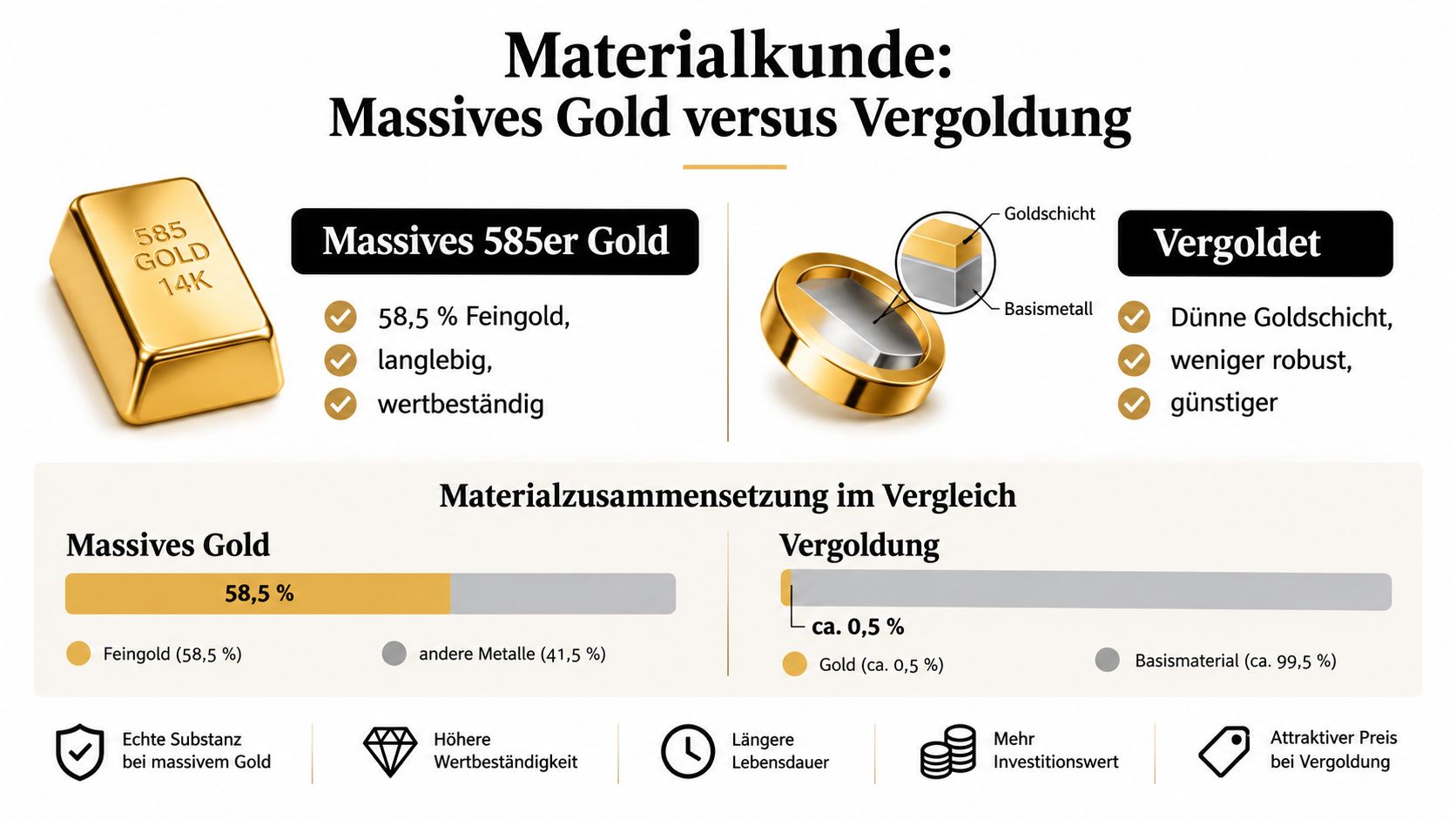
The most important difference is not in the color but in the material composition. Solid 585 gold contains 58.5% pure gold, while gold-plated jewelry carries only a layer of gold over a different base material. These two products should not be treated as equivalent alternatives.
How to read the hallmark correctly
Under the German Fineness Act, the gold content is stated in thousandths. The number 585 means 585 out of 1,000 parts by weight are pure gold, equivalent to 58.5% gold. The remaining 41.5% consists of alloy metals that influence, among other things, hardness and color. The German legal text on fineness also stipulates that, for gold jewelry, the stated fineness may deviate by no more than 10 thousandths from the actual fineness of the fully melted item.
Therefore, look for a specific three-digit marking such as 585. Terms such as “gold look,” “gold-colored,” or an unclear reference to “14 K” do not replace transparent material labeling. Gold-plated goods must not simply be described as solid gold.
| Material | What you receive | My assessment |
|---|---|---|
| Solid 585 gold | A gold alloy containing 58.5% pure gold | Suitable for a lasting keepsake |
| Gold-plated jewelry | A layer of gold over another base material | More suitable for decorative use, not as an equivalent replacement |
| Gold-colored material | An optical color effect without a clear statement that it is gold | Choose with caution for a meaningful birth gift |
Nickel and skin tolerance
Gold itself is not automatically the problematic component. Alloying metals can affect skin tolerance. NDR explains the significance of additives such as nickel and points out that nickel can cause skin irritation in sensitive individuals. The Bavarian State Office for Health and Food Safety describes nickel as one of the most common contact allergens in Europe, as explained in the information on nickel allergy.
Ask the retailer about the specific alloy and information on nickel release. “Nickel-free” does not automatically mean “allergy-free,” and “gold” alone says nothing about every alloying metal. A comprehensible product description, a consistent receipt, and an appropriate fineness stamp create more trust here than blanket quality claims.
Anyone wishing to explore the differences between alloys in greater depth can find additional guidance in 585 gold in jewelry. For a baby bracelet, my decision remains clear: If gold is to be given as a gift, the material specification should be transparent, verifiable, and not confused with mere plating.
Safety aspects and child-friendly design
High-quality material does not automatically make a baby bracelet safe for babies. Small plates, loops, chain links, or clasp components can come loose, enter the mouth, and be swallowed or inhaled. A band that is too tight can cause pressure marks or impair circulation, while a model that is too loose can get caught.
The pediatric guidance on jewelry for babies advises particular caution with freely moving jewelry. The practical recommendation is clear: Do not let babies wear it while sleeping, during unsupervised play, or as permanent everyday jewelry.
The construction is decisive
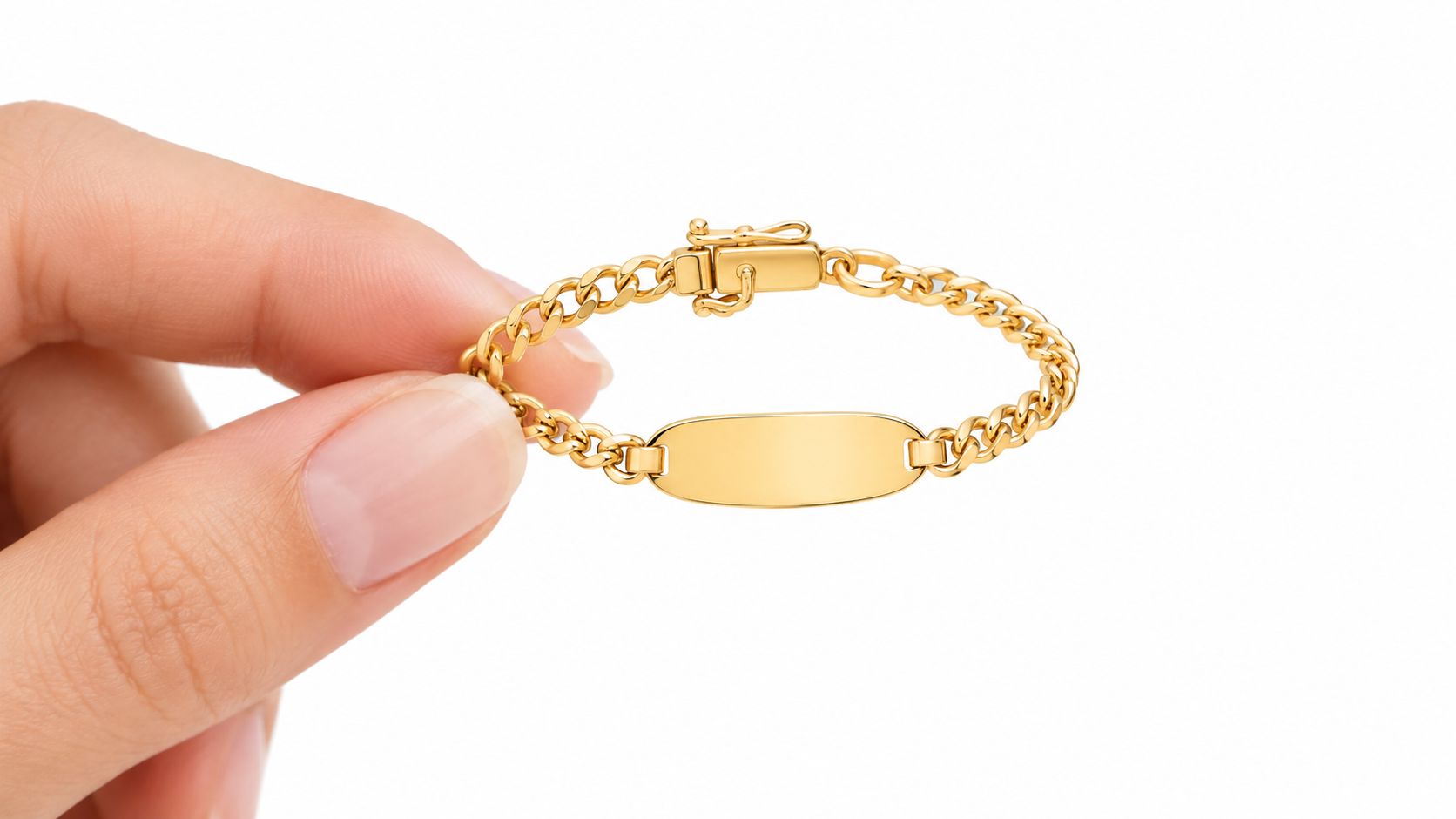
Do not inspect a model only from the front. Turn it over, move the clasp carefully, and examine every connection. A good baby bracelet should have as few small individual parts as possible, rounded edges, and an engraving surface that is firmly attached to the bracelet.
The position of the engraving is particularly important. A flat, integrated plate is preferable if it has no sharp edges or protruding material ridges. A separate pendant adds extra loops and connection points. For a gift that is initially presented symbolically and later stored, this more streamlined design is the more sensible choice.
Safety rule: The bracelet must not combine the appearance of everyday jewelry with the use of an unsupervised baby item. Give it as a keepsake and put it on only under direct supervision.
Your checklist before first wearing
- Check the clasp: Before each use, check that the clasp closes securely and that no connection is loose.
- Assess the fit: The band must not press against the skin or fit so loosely that it can snag or be easily slipped off.
- Inspect the components: Remove the bracelet immediately if a link becomes deformed, an edge develops, or a component appears loose.
- Limit wearing time: Remove it during sleep, unsupervised play, and situations involving a risk of snagging.
- Provide supervision: An adult should directly observe the child while the bracelet is being worn.
An independent pediatric safety assessment emphasizes that age, body location, clasp, workmanship, and supervision must be considered together. The safety information on children's name bracelets can supplement the selection process, but does not replace a careful inspection of the specific item.
The material itself is also part of safety. The German Federal Institute for Risk Assessment warns against lead-containing costume jewelry for children because swallowed parts can be particularly problematic. With a gold bracelet, parents should therefore take the origin, material information, and workmanship just as seriously as the engraving.
Engraving options and personalization
The best engraving is not the longest. It remains legible, unambiguous, and emotionally meaningful, even when the child is an adult. For a baby bracelet, the first name, a birth date, or a short combination of the two is therefore usually suitable.
Four steps to the right engraving
1. Choose information with lasting value. A first name is personal and immediately identifiable. A date documents the occasion. A birth time can be meaningful if it has special significance for the family. Avoid wording whose meaning is clear only at the moment of giving the gift.
2. Check the available space. A small plate requires a different layout than a longer engraving area. Before ordering, ask to see how the name, symbols, and date will be arranged. A short, legible line is preferable to an overcrowded text.
3. Choose a simple font. Ornate fonts can quickly become unclear on a small surface. A clear engraving with sufficient spacing between letters remains easier to read over time. Symbols such as a heart may be suitable, but they should not overshadow the name.
4. Use the back thoughtfully. The name can go on the front, with a date or a short dedication on the back. This separation creates order and prevents the central information from getting lost among decorative symbols.
The engraving should be flat, clean, and free of sharp edges. Its emotional value comes from the choice of information, not from the most conspicuous decoration possible. For a birth gift, restraint is often the more personal choice.
Care and durability of gold jewelry
A gold bracelet does not automatically remain flawless simply because it is made of a durable alloy. Skin oils, dust, friction, and personal care products can diminish its shine. Proper care therefore combines gentle cleaning, safe storage, and regular inspection.
Treat it properly in everyday use
Remove the bracelet before bathing, swimming, or coming into contact with personal care products. Water alone is not the only factor. Soap residue, creams, and chemical substances can accumulate on the clasp and engraved surface or place unnecessary strain on the surface.
Wipe the piece of jewelry with a soft, clean, non-abrasive cloth. Do not use a hard brush or harsh household cleaning products. Do not scrape the engraving with sharp objects, as this can create rough edges or scratches.
Care principle: Gentle cleaning protects more than frequent polishing. Preserve the original condition rather than removing material from the surface.
Storage and inspection
Store the bracelet separately from other jewelry, ideally in a soft jewelry box. This prevents unnecessary friction on the engraving plate and keeps the chain links from catching on other pieces. The gift box can also become the designated storage place when the bracelet is not being worn.
Check the clasp and connections before every special occasion. If visibly damaged, the jewelry should not be placed on the child's wrist. A jeweler can inspect the workmanship and professionally refresh the surface without unnecessarily affecting the engraving.
Read the information on the warranty, care, and returns before buying. Also clarify how the provider handles an incorrect engraving or a damaged clasp. A personalized piece of jewelry is a long-term purchase, so customer service should remain easy to reach and understand even after the order.
Conclusion and why an engraved gold bracelet lasts
An engraved gold baby bracelet is a good choice when material, safety, and meaning are aligned. Choose a verifiable fineness specification, check the alloy for potentially problematic additives, and do not treat the bracelet as unsupervised everyday jewelry.
The engraving should clearly display the name or an important date. A firmly integrated plate, rounded edges, and a secure clasp that can be checked are more important than additional charms or eye-catching details. This keeps the gift personal without unnecessarily increasing mechanical risks.
The true value lies in the perspective of time. A piece of clothing recalls a phase, while an engraved gold bracelet can preserve a family history for many years. Present it thoughtfully, explain safe use to the parents, and store it away when the baby is unattended.
Visit OTANTO if you are looking for a customizable piece of jewelry with a name, word, or date and value careful gift presentation. Before ordering, check the specific material information, engraving options, and the guidance on care, warranty, and safe use so that the gift becomes a responsibly chosen keepsake.


