



585 gold ring
How can you tell whether a 585 gold ring represents genuine material value, a suitable alloy and a skin-friendly piece of jewelry, or whether you are simply placing too much trust in a small stamp? The number 585 is important, but it guarantees neither freedom from allergies nor a particular quality of workmanship, and certainly not that the purchase price corresponds to the pure gold value.
Anyone who wears a ring every day should therefore consider three things separately: the fineness, the composition of the other metals and the workmanship. Only this combination shows whether a ring suits your everyday life, your skin and your idea of personal jewelry.
Table of contents
- The significance of the 585 hallmark
- 585 gold compared with 333 and 750
- Skin compatibility and allergy risks
- Pricing and the true material value
- Personalization through engravings
- Care and preserving value in everyday life
- Checklist for the perfect ring purchase
The significance of the 585 hallmark
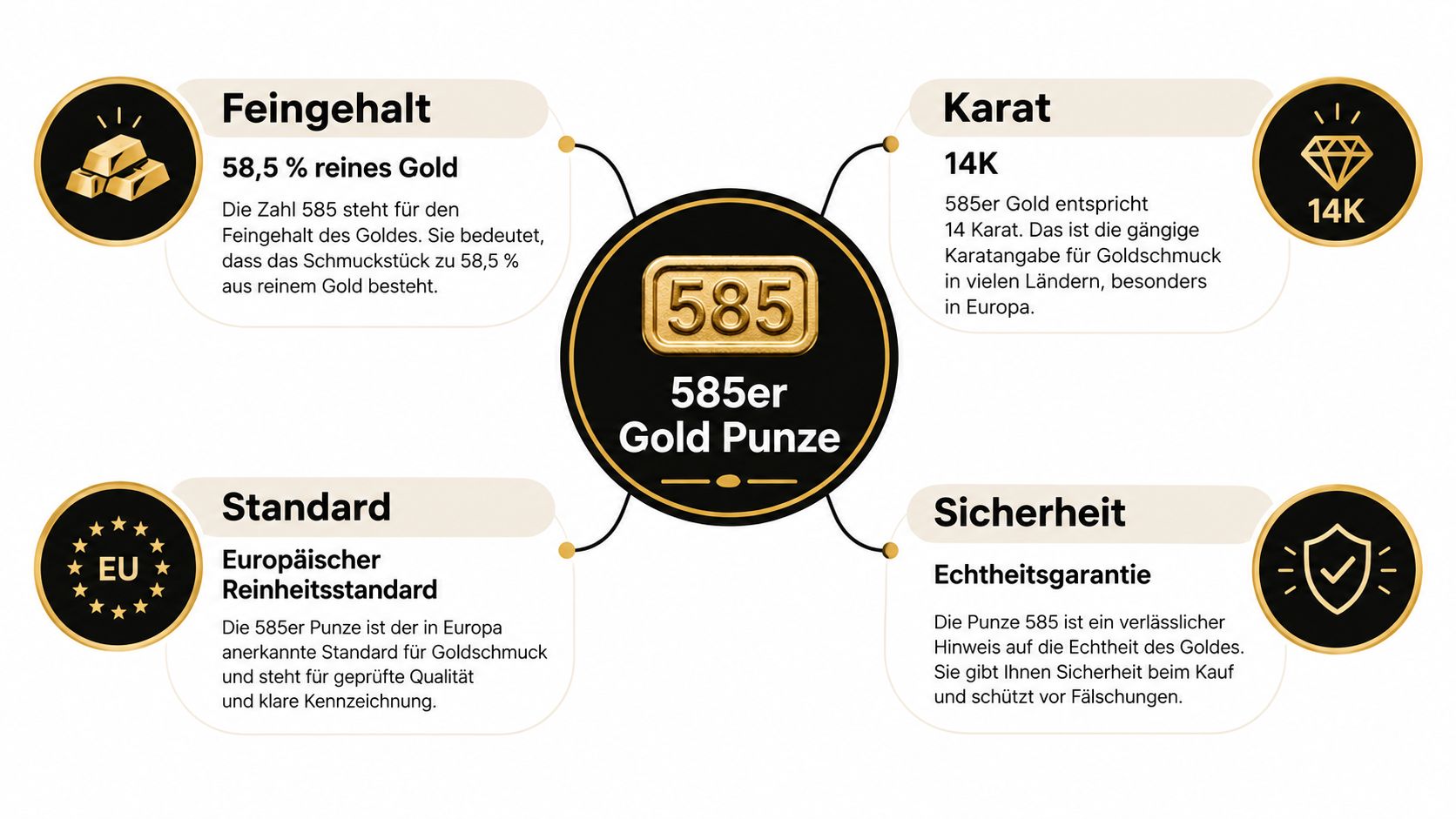
What does the number 585 actually indicate? According to the German fineness specification, a 585 gold ring consists of 585 out of 1,000 parts by weight of pure gold, that is, 58.5% gold. The remaining 415 parts by weight, or 41.5%, consist of other metals. The German Fineness Act permits gold and silver jewelry to be marked with its fineness in thousandths.
An example makes the specification tangible. If a ring weighs 10 grams in total, theoretically 5.85 grams of that is pure gold. The remaining 4.15 grams make up the alloy. These additional metals do not automatically make the ring inferior. Rather, they give the material properties that pure gold does not sufficiently possess for a heavily used ring.
Gold content and suitability for everyday wear
Pure gold is soft. Copper, silver, palladium or other components can change the hardness, color, castability, malleability and polishability. That is why a 585 gold ring is interesting as an alloy for everyday wear: It combines a clearly defined gold content with a technically more durable material mixture.
The designation stands for approximately 14 karats. The karat system divides the alloy into 24 parts. 14 of 24 parts correspond mathematically to around 58.33%, which corresponds to the standardized fineness of 585. The crucial point is: 585 describes the gold content, not the ring size, style or quality of workmanship.
Practical rule: Read the hallmark as a material declaration. To make a purchasing decision, you also need information about the color, alloy, finish, workmanship and, where applicable, the gemstones.
The hallmark also does not automatically indicate the origin or place of manufacture. In Germany, the seller is liable for the accuracy of the stated fineness indication. For fully melted-down jewelry, the legally permitted margin of error may be no more than 10 parts per thousand, as stated in the Fineness Act. You can also find a further explanation of the material designation at Jewelry Made of 585 Gold.
585 gold compared with 333 and 750
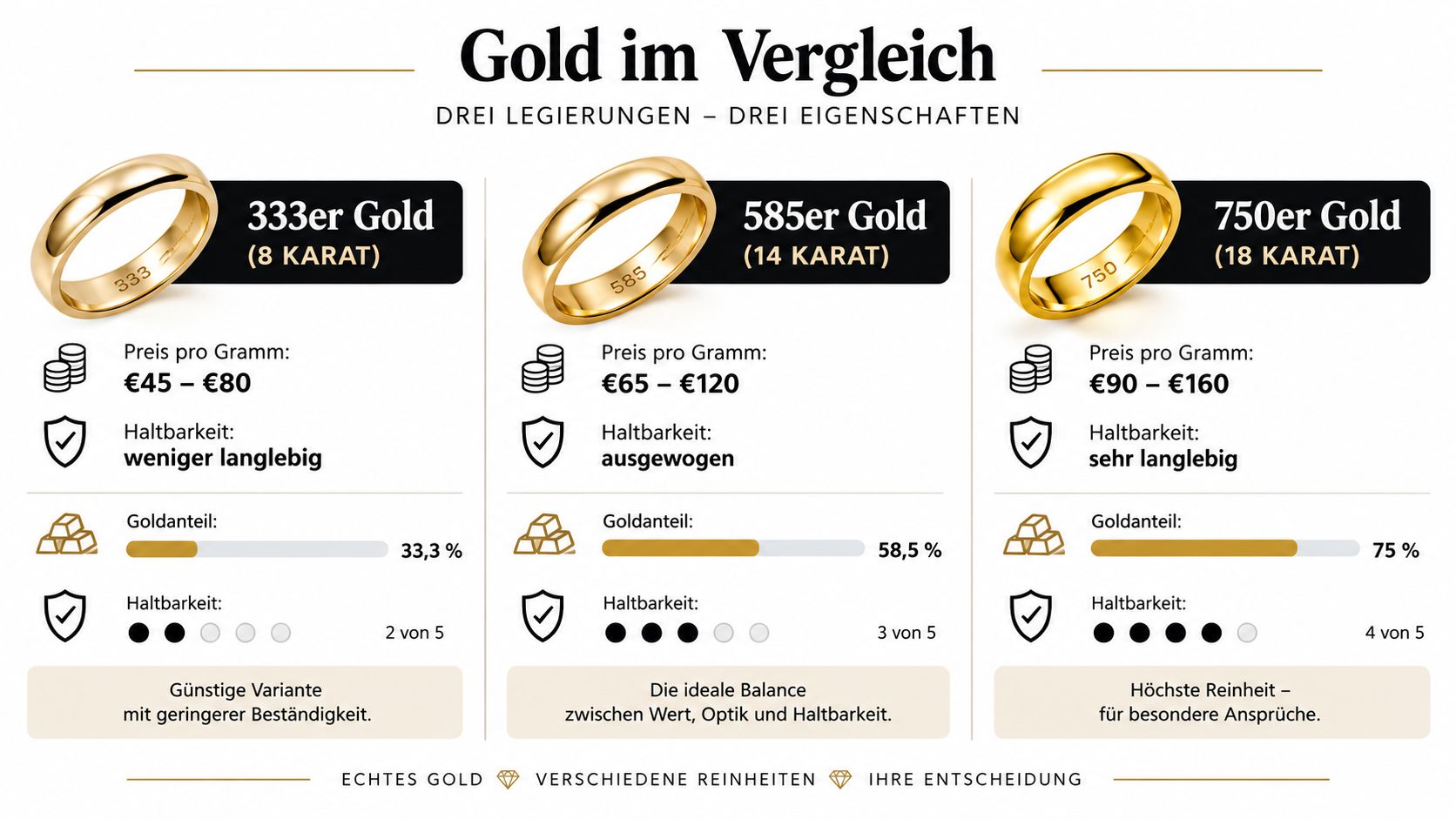
Comparing different gold grades quickly leads to a false conclusion: more gold does not automatically mean that a ring is better suited to your life. 333, 585, and 750 gold differ in gold content, color, and the properties of their respective alloys. The right choice therefore depends on how often you wear the ring and which material character you prefer.
333 gold contains 333 of 1,000 parts by weight of gold. It is often chosen as a more budget-conscious option, but has a significantly lower gold content than 585 gold. Its color may appear paler, while the other metals more strongly determine the character of the alloy.
585 gold is in the middle. Its gold content is significantly higher than that of 333 gold, while the alloy content ensures good suitability for everyday wear. This combination is particularly suitable for rings that are worn regularly and do not come out of the jewelry box only on special occasions.
When 750 gold makes sense
750 gold contains 750 of 1,000 parts by weight of pure gold, equivalent to 75% gold. The color usually appears richer, and the higher gold content makes the alloy particularly valuable. For many people, this is an aesthetic and emotional advantage, but the mechanical stress on a ring worn every day should also be taken into account.
The lower gold content of 585 gold is therefore not a flaw. For a ring worn on your finger, hardness and resistance may be more important than the highest possible purity. A ring made of 750 gold may be exactly right for you if you are looking for an intense color and higher gold content. However, anyone who frequently works with their hands should examine the specific alloy and ring construction particularly carefully.
| Gold grade | Material statement | Typical consideration |
|---|---|---|
| 333 | Lower gold content | Budget-conscious choice; check the color and alloy carefully |
| 585 | Approximately 14 karats | Balanced compromise for many everyday rings |
| 750 | 75% pure gold | Richer color and higher gold content; consider material properties |
So don't blindly choose the highest number. Ask yourself whether color, quality, durability, and budget harmonize with one another.
Skin compatibility and allergy risks
Is a 585 gold ring automatically suitable for allergy sufferers? No. The hallmark only describes the gold content. It says nothing about the remaining 41.5%. Those remaining metals may include substances that trigger a reaction in sensitive skin.
With white gold, the exact composition is particularly important. Nickel-containing alloys can be problematic for people who are sensitized to nickel. With rose gold, the higher copper content may be relevant. This does not mean that everyone reacts to these metals. It does mean, however, that the stamp alone does not provide any medical indication of skin compatibility.
What information you should request when buying
Ask the seller about the specific alloy composition, not just the color designation. If you have a known nickel allergy, nickel-free options are an obvious choice. Palladium-containing white gold can provide a bright white-gold tone without requiring a nickel-containing formulation.
For example, documented nickel-free, palladium-containing 585 white gold consists of 585‰ gold, 295‰ silver, 100‰ palladium, 10‰ copper, and 10‰ zinc. For this material condition, a density of 14.9 g/cm³ and a Vickers hardness of 75 to 85 HV 5/30 are specified, as shown by the technical data sheet for 585 white gold. These values describe a specific alloy, not every piece of jewelry stamped 585.
For sensitive skin, the composition matters, not just the number stamped inside the ring.
Also check for possible rhodium plating. It can brighten the surface visually, but it is not the same as a nickel-free base alloy. Friction, sweat, soap, and disinfectants can further contribute to skin irritation. If redness, itching, or persistent symptoms occur, remove the ring and have the cause evaluated by a dermatologist.
Pricing and the true material value
Why does a 585 gold ring cost significantly more than its calculated gold content? Because the selling price does not pay for just the metal. A ring is a processed product. Its price includes, among other things, design, labor, tools, setting, surface treatment, gemstones, operating costs, margin, and VAT.
The theoretical metal value can nevertheless be calculated in a transparent way:
- Determine the ring's total weight.
- Multiply the weight by 0.585 to determine the theoretical fine gold content.
- Multiply the fine gold content by the current daily fine gold price.
- Understand the result as a guide, not as a binding selling price.
With a ring weight of 6.0 grams, the fineness specification corresponds mathematically to 3.51 grams of pure gold. The remaining 2.49 grams consist of additional metals, as explained in the explanation of 585 gold alloys. However, the calculation says nothing about how much working time goes into a handmade ring or what value a special design has.
Purchase price and resale price are different figures
When buying new, you pay more than the melt value. A delicate ring may be more expensive than a heavier, plain model because of elaborate manufacturing, a complicated setting or an engraving. A stone is also not valued solely by its weight, but by its properties and how it is incorporated by the craftsperson.
When it is sold later, however, what often matters more is how much recoverable material the dealer can buy. The purchase price may therefore be below the theoretical metal value, while the new purchase price is significantly higher. The information on the material value of 585 gold makes this difference clear without anticipating the selling price of a specific ring.
A transparent product description should therefore state ring weight, fineness, color, alloy and any stones. The description of a men's 585 gold necklace offers further guidance on classifying 585 jewelry.
Personalization through engravings
A ring does not become personal through its shape alone. Often, it is the engraving that turns a beautiful piece of jewelry into a keepsake. An inner engraving can feature a date, initials or a short message. It remains discreet and is intended for the person wearing the ring.
A wider ring band also allows graphic designs to be implemented. A one-line art engraving can show a minimalist silhouette, while a fingerprint engraving creates a particularly individual surface. When making your choice, the available space should determine the design. A narrow band calls for clear characters and an easily readable font, while a wider profile allows finer image details.
Font, design and ring profile
Classic lettering looks calm and timeless on a smooth inner surface. Script can appear more emotional, but it requires sufficient space and must remain clearly legible. For a personal gift, it makes sense to compare the length of the message with the available engraving area before ordering.
The amount of material removed during engraving is minimal. It normally changes a ring's total weight only slightly, but the technical execution determines the sharpness of the edges and the legibility. 585 gold provides a balanced basis for precise engravings due to its alloy components. This does not mean that every engraving will remain unchanged permanently. Engraved surfaces can also appear softer due to scratches and signs of wear.
A good engraving is not as long as possible. It is chosen so that it remains legible and meaningful even years later.
For a gift, you can adapt the message to the occasion. A date suits an anniversary, initials are suitable for a personal everyday ring, and a minimalist line motif can represent a shared memory. You can find a selection of personalized ring ideas at engraved rings for women. It remains important to check the spelling, order, and characters carefully before approval, as personalized items cannot always be returned like standard products.
Care and preserving value in everyday life
A 585 gold ring does not tarnish in the same way as silver. Nevertheless, its shine can fade. Skin oils, soap residue, creams, and cosmetics settle on the surface and make the metal appear duller. With daily wear, small scratches and pressure marks are added over time, forming an individual patina.
For cleaning at home, warm water, mild soap, and a soft brush are usually sufficient. Carefully loosen the dirt, rinse the ring thoroughly, and dry it with a soft, lint-free cloth. Hard brushes, toothpaste, and baking soda are not suitable standard cleaning agents because abrasive particles can scratch the surface.
Avoid stress, preserve the shine
Take off the ring during activities where hard impacts, dirt, or chemicals are likely. These include gardening, equipment-based workouts, and contact with pool water. Taking a short break while applying lotion or using cleaning products is also advisable.
- Wipe daily: A soft cloth removes residue before it settles.
- Clean gently: Use warm water and mild soap without rubbing too hard.
- Store separately: A separate case or fabric pouch protects it from contact with other jewelry.
- Monitor the surface: If scratches become bothersome, a goldsmith can professionally inspect and refinish the ring.
- Check the setting: Rings with stones should have their setting professionally inspected regularly.
The following video additionally shows what gentle jewelry care can look like in everyday life.
Accept signs of wear as part of the story, or opt for professional refinishing later. A goldsmith can assess whether polishing, matting, or a repair makes sense. With coated white gold surfaces, you should also clarify whether renewed surface treatment is required.
Checklist for the perfect ring purchase
A good purchase does not begin with the shiniest model, but with clear questions. Check the following points before ordering a 585 gold ring or choosing one at a jeweler:
- Determine the fit: Measure your ring size at a time of day when your fingers are neither unusually cold nor significantly swollen. The band width can influence how a ring feels.
- Look at the hallmark: Look for the 585 mark and ask the seller to explain how they substantiate this specification.
- Ask about the alloy: For white gold, ask about its nickel content, and for rose gold, ask about its specific composition. Color alone is not enough.
- Separate weight and price: Ask for the ring weight and consider the metal value calculated from it only as a guideline. Design, labor, stones, and the retailer's margin also contribute to the purchase price.
- Choose the finish: Decide whether polished, matte, or coated gold suits your everyday life. A finish can affect care and later refinishing.
- Check the engraving: Check the text, date, initials, and spelling before approval. With image engravings, the design should remain clearly recognizable on the intended ring profile.
- Assess your everyday life honestly: If you often do manual work, play sports, or do not want to take the ring off during any activity, mechanical durability should be particularly important.
- Read the service terms: Clarify the return policy, warranty, resizing, care, and conditions for personalized items before purchasing.
The best choice is not automatically the highest fineness rating. It is the ring whose alloy, shape, finish, and personalization suit your skin, your everyday life, and the meaning you want it to convey.
If you are looking for a personalized ring or another piece of jewelry with a name, date, text, or one-line art, OTANTO offers handmade jewelry from Germany and its own 585 gold collection. Before ordering, check the information on the material, engraving, care, and returns so that your piece of jewelry suits you not only when you unpack it, but also in everyday life.


