



Baptism Jewelry: The Complete Gift Guide
The christening card is signed, the outfit is ready, and the only thing missing from the gift table is the right present for the godchild or granddaughter. A cross pendant? A name necklace? Or perhaps a piece of jewelry that will only be worn later?
Especially when it comes to jewelry for a christening, many people face the same questions: Which material will stay beautiful for a long time? What can a baby wear at all? And how can a pretty gift become a personal keepsake that still holds meaning for First Communion or Confirmation?
Table of contents
- Why jewelry for a christening is more than a gift
- Symbols and Their Meaning in Baptism Jewelry
- Materials compared, from silver to 585 gold
- Name necklace pendants and engravings as keepsakes
- Understanding baby jewelry safety
- Comparing budget sizes and gift boxes
- Care, storage, and passing it on
- Jewelry from baptism to confirmation
Why jewelry for a christening is more than a gift
A christening is not an occasion where price alone determines the quality of a gift. Jewelry can make the day tangible, carry a personal message, and later preserve a connection to an important family moment. That is precisely why it is worth looking not only for the most beautiful shine, but for a piece that suits the child, the family, and the occasion.
Imagine giving the child a small pendant engraved with their name and christening date. On the day of the christening, it initially rests in a gift box. Years later, it is brought out for First Communion, together with the christening candle and the first family photos. Perhaps the child wears it themselves for the first time then. Its value does not lie in having been worn constantly, but in preserving a story.
Symbolism that extends beyond the day of the christening
A cross can be a reminder of the Christian faith, while an angel can represent protection and guidance. A tree of life stands for growth, roots, and family. With an engraving, a generally suitable symbol becomes a personal piece that clearly belongs to this child.
Despite declining ties to the churches, christenings remain an important occasion for giving gifts. In 2024, the Catholic Church reported 116,274 christenings, while the Protestant Church reported 113,586 christenings. Together, the published figures amount to more than 229,000 church christenings, although the denominations use different age limits and statistical definitions. The figures come from the church christening statistics for Germany.
A smaller occasion market requires good decisions
In Germany, 677,117 children were born alive in 2024, the lowest birth rate since 2013 and around 25 percent lower than in 1990. For christening gifts, this does not mean the occasion is disappearing, but rather that personal quality matters especially to this target audience. The birth statistics from the Federal Statistical Office also show that the total fertility rate fell from 1.41 children per woman in 2012 to 1.35 in 2024.
Expensive baby jewelry is not automatically more valuable. A well-chosen, engraved pendant can preserve more emotional value because it is intended for later.
Symbols and Their Meaning in Baptism Jewelry
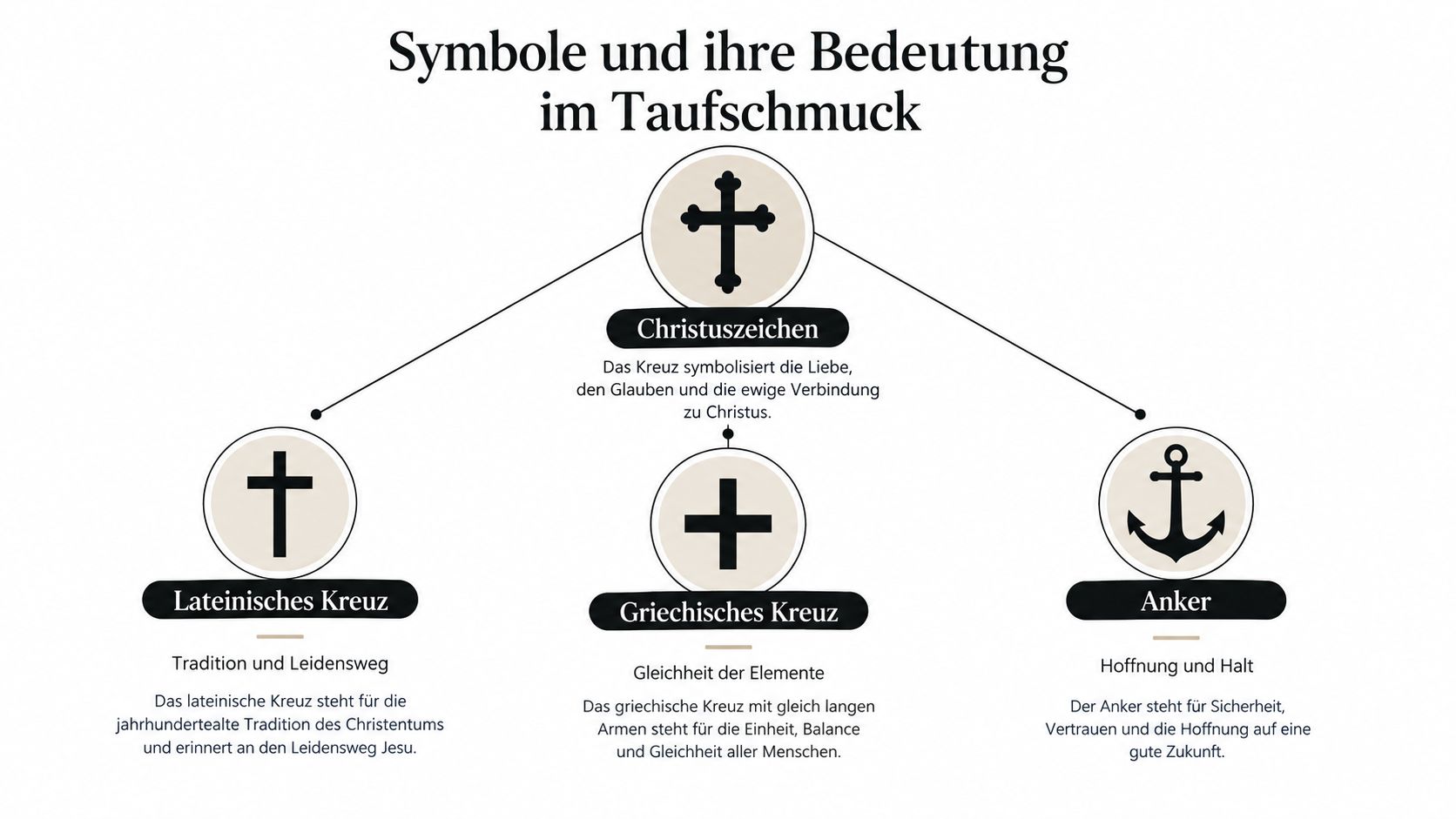
At the jewelry counter, one simple question helps: What message should the symbol convey? Only then should you decide on the shape, size, and engraving. This way, the pendant does not seem arbitrary but tells a coherent story.
The cross as a clear symbol of Christ
The cross is the most obvious Christian symbol. A Latin cross has a traditional appearance and emphasizes the connection to Christ and his Passion. A Greek cross with arms of equal length appears more balanced and often somewhat lighter in design. A cross with a tree of life combines the Christian symbol with the idea of growth and family roots.
For a child, a small, smoothly finished cross pendant is usually more suitable than a heavily embossed design with many protruding details. The first name can be placed on the back, while the baptism date adds a second personal element.
Fish and anchor as subtle symbols
The fish, also known as Ichthys, is considered a historical identifying symbol of early Christians. Its round, closed shape is understated and suitable as a small pendant or as an element on a simple bracelet.
The anchor stands for hope and stability. It is not a traditional baptism symbol in the same sense as the cross, but it can suit a family that wants to give the child a sense of stability and confidence. A small anchor with an initial is understated and can later be combined easily with other jewelry.
Tree of life and angel
The tree of life is particularly suitable for families who want to emphasize the ideas of growth, origins, and togetherness. An engraving with an initial or name turns the design into a personal family symbol.
The angel is often given as a protective figure. It suits a medallion, a small charm, or a flat pendant. What matters is not whether the angel is intended for a girl or a boy, but whether its meaning suits the relationship between the giver and the child.
The most beautiful combination is often simple: a symbol on the front, and the name and baptism date on the back.
Materials compared, from silver to 585 gold
For children's skin, it is not just the color of the metal that matters. Material information, surface finish, and all points of skin contact must be traceable. This applies to the pendant as well as to loops, clasps, and engraving plates.
For prolonged direct skin contact, jewelry in the EU may release no more than 0.5 micrograms of nickel per square centimeter per week. For parts inserted into pierced body sites, the stricter limit of 0.2 micrograms per square centimeter per week applies. The German Federal Environment Agency's information on nickel allergy shows why clear information about materials and coatings is important.
Four materials, four different decisions
Silver is a classic choice for pendants, crosses, and medallions. It has a subtle appearance, can tarnish, and should only be purchased for sensitive skin when clear material information is provided. Silver can be a good fit for a keepsake that is mainly stored and worn on special occasions.
Stainless steel appears durable and suitable for everyday use. Nevertheless, you should not rely on the label alone, but ask about the exact alloy and skin contact. In cases of known allergies, documented, suitable materials are more important than mere appearance.
Nickel-free or low-allergen alloys can be a targeted option if a sensitivity is known. Ask for confirmation that not only the visible surface but also the loops, clasp, and back have been selected accordingly.
14-karat gold is a durable and valuable choice for a keepsake to be treasured across generations. The higher material value is worthwhile if the pendant is to be kept for a long time, worn later, or passed down within the family. Information about jewelry made of 14-karat gold can help you assess the alloy.
| Material | Price range | Allergy risk | Suitability for children's skin |
|---|---|---|---|
| Silver | low to medium | depends on the alloy and coating | suitable with clear material information |
| Stainless steel | low to medium | depends on the specific alloy | durable, check the selection carefully |
| Nickel-free alloy | medium | lower risk with documented composition | advisable if sensitivity is known |
| 14-karat gold | medium to high | usually easy to assess with a suitable alloy | durable option with clear material information |
Name necklace pendants and engravings as keepsakes
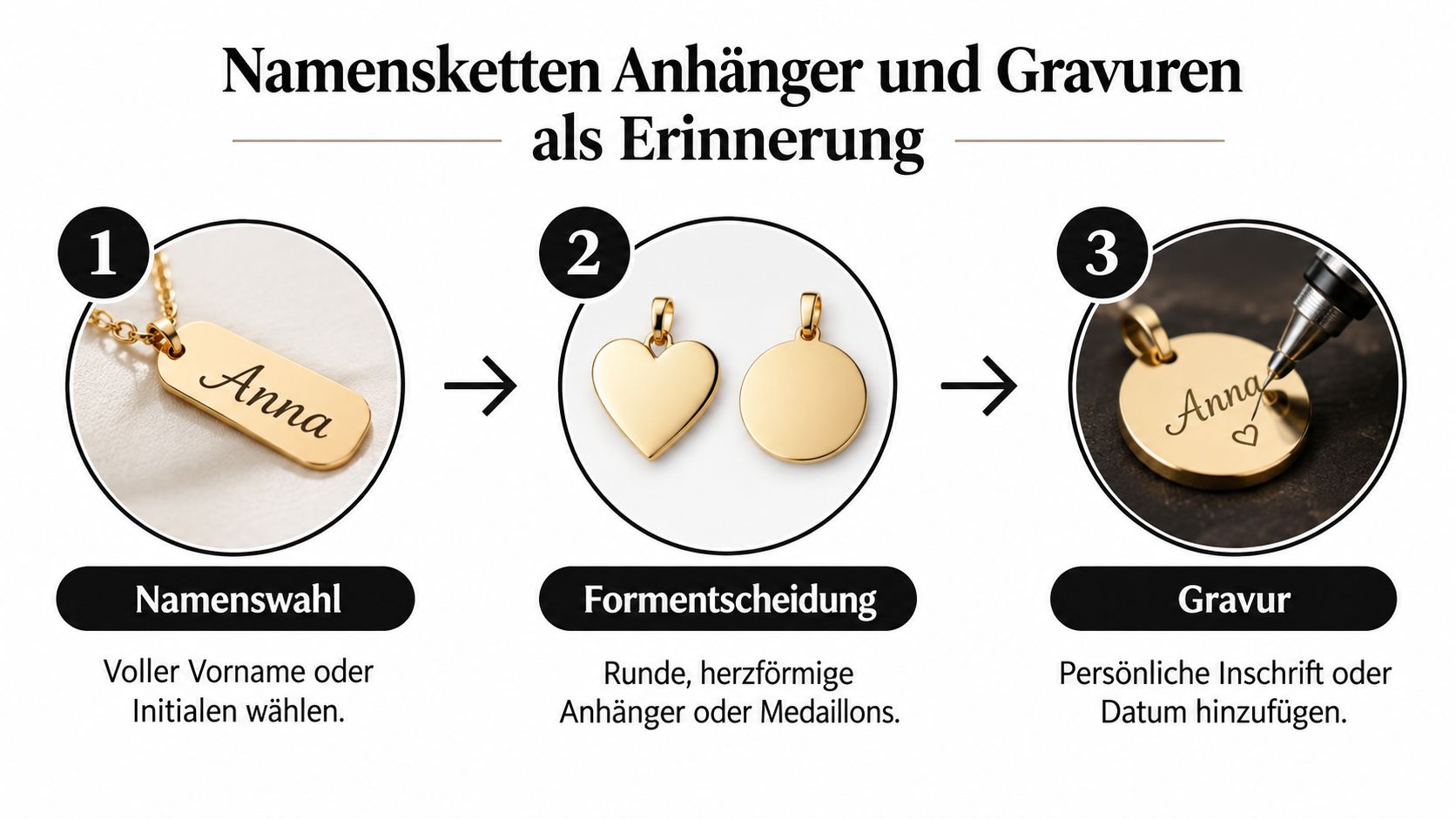
An engraving makes the difference between a beautiful piece of jewelry and a personal keepsake. The pendant does not need to contain as much text as possible. A name, baptism date, and a small symbol are often enough if they are clearly legible and arranged thoughtfully.
Finding the right shape
A name necklace with a full first name looks direct and personal. Initials work well on small pendants when space is limited or the jewelry is intentionally understated. Round and heart-shaped pendants provide a clearly visible surface for a front design.
A locket is suitable if an additional photo or small keepsake is to be stored inside. An adjustable children's bracelet can grow with the child, but should still only be worn under supervision if it is intended for a baby or toddler.
Do not overload the engraving
A tried-and-tested layout looks like this:
- Front: symbol, initial, or first name.
- Back: christening date or a short blessing.
- Second line: add one only if the text remains legible.
For delicate children's names, a legible font is more important than an especially ornate design. A star, cross, or tree of life can complement the engraving, but should not overshadow the name.
Matching jewelry for the godmother and the child is also possible. For example, the child receives a pendant with their name, while the godmother wears a matching symbol with a short personal engraving. A selection of name necklaces for children shows how these styles can differ.
If the pendant is to be worn by the child later, do not plan the engraving only for the christening day. It should still look appropriate for a school-age child and an adult.
Understanding baby jewelry safety
Many families would like the baby to wear the new jewelry during the christening. The wish is understandable, especially for photos. However, this decision is not automatically safe. Chains, bracelets, and small pendants can be put in the mouth, licked, sucked, or swallowed while playing.
The German Federal Office of Consumer Protection and Food Safety specifies maximum limits for jewelry of 0.01% by weight of cadmium and 0.05% by weight of lead. The BVL guidance on costume jewelry and contact with children makes it clear that material exposure must be taken particularly seriously in children.
Wear only under direct supervision
For babies and children under one year old, necklaces should not be recommended as everyday jewelry. Necklaces that are too long, tight bracelets, loose beads, protruding components, sharp edges, and small clasps can increase the risk of injury, swallowing, or entanglement.
The safer solution is often very simple: Present the piece of jewelry in a box, while the child is photographed wearing it only briefly and under close supervision. The jewelry should be removed during sleep, crawling, play, and transport.
What adults should look out for
Before buying, check that the pendant is securely attached and contains no loose small parts. Durable, non-magnetic clasps and tear-resistant materials are sensible selection criteria. An age-appropriate safety notice should be part of the gift.
This preserves the meaning without creating the impression that a baby needs to wear jewelry constantly. An engraved pendant can be safely stored for many years and used later, exactly when the child can consciously appreciate it.
Comparing budget sizes and gift boxes
A sensible budget does not start with the price tag, but with the question of what the piece of jewelry is intended for. Is it simply to be presented symbolically at the baptism? Will it be worn regularly later? Or should it last for generations as a high-quality family heirloom?
In budget-friendly options, simple shapes, smaller pendants, and understated engraving are usually the focus. In the mid-range, sturdier designs, more secure clasps, and greater choice in shape and personalization are often available. High-quality pieces may be made from durable precious metal and offer more elaborate workmanship.
Quality features by budget
| Price range | Material | Engraving options | Suitable for |
|---|---|---|---|
| low | Silver, stainless steel, or suitable alloy | Name, initial, or short date | symbolic gift and later handover |
| medium | Silver, suitable alloy, or gold-plated finish | Name plus date or small symbol | personalized baptism pendant for the keepsake box |
| high | 585 gold or other clearly specified precious metals | multi-line engraving, special shape, or custom-made piece | long-lasting family heirloom and keepsake |
For every price range, have the engraving method explained. Workshop engraving and laser engraving can look different. More important than the label is whether the lettering is clearly legible, the surface remains protected, and no sharp edges are created.
Size, length, and fit
For a chain, the clasp should be secure and the length appropriate. Adjustable elements can be helpful, but they do not replace regular checks. A chain must not be so long that it gets caught during play.
For bracelets, adjustable models are practical because children grow. Nevertheless, the band must neither cut into the skin nor be so loose that it can get caught. For babies and toddlers, safe storage should take priority over wearing the jewelry right away.
The gift box as part of the handover
A velvet box looks festive, while an engraved wooden box creates a lasting place for storage. A jewelry pouch saves space, but only provides sufficient protection if it is stored in a dry, secure place.
If godparents cannot attend in person, the packaging should still make the occasion feel special. A sturdy gift box, a personal card, and clear instructions for safe wearing convey that this is not just an object being given, but a memory.
Care, storage, and passing it on
A baptism pendant will stay beautiful only if the family treats it properly. Silver can tarnish, while gold and coated surfaces can also suffer from perfume, chlorine, salt water, or friction. For care, a calm routine is usually enough instead of aggressive cleaning products.
Clean gently
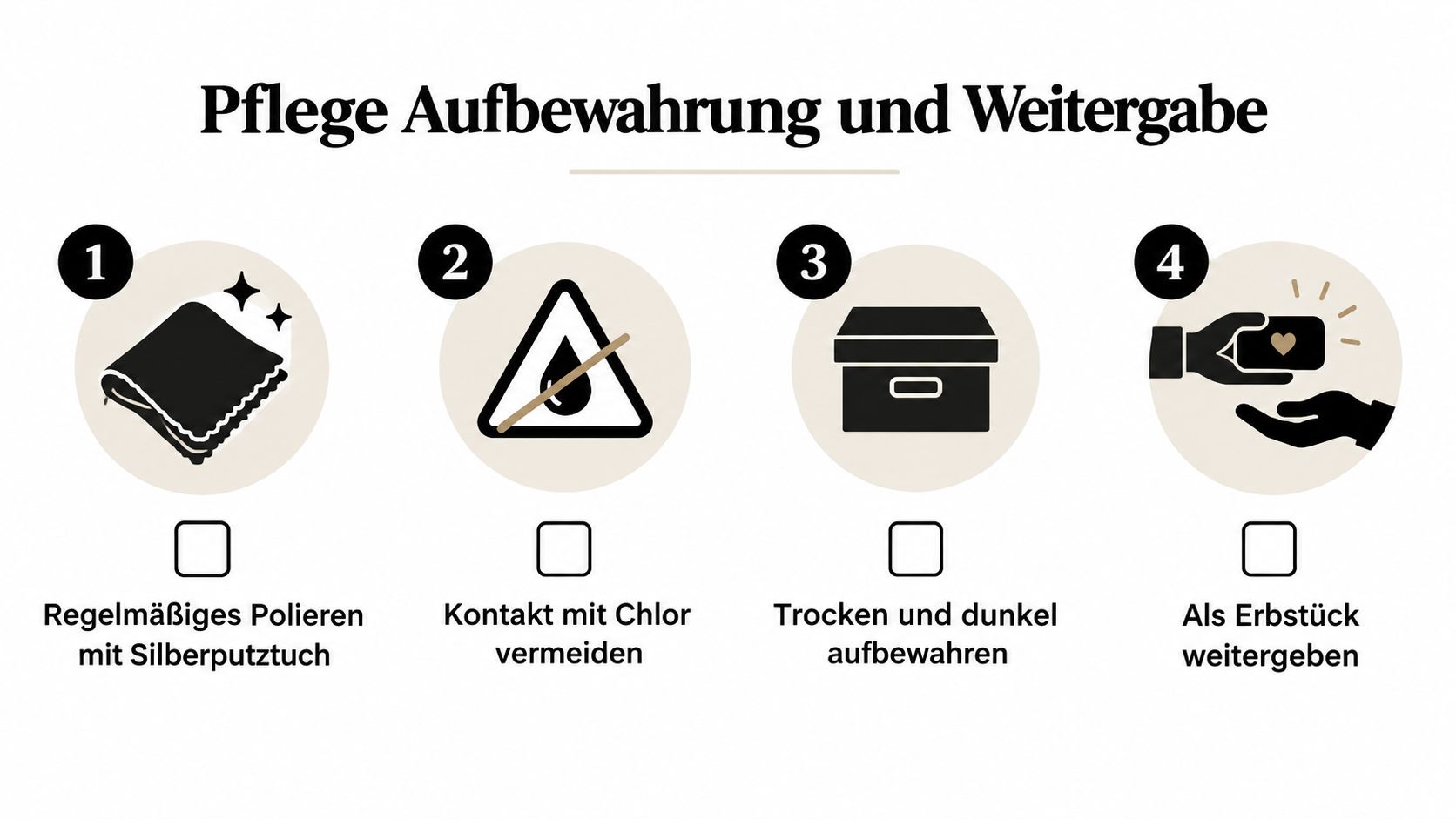
Polish silver carefully with a soft silver polishing cloth. Dirt tends to collect in the indentations of engraved pendants. A very soft toothbrush can help there, as long as you work without pressure and wipe the surface dry afterward.
Avoid contact with chlorine, salt water, and perfume. Remove the jewelry before bathing, swimming, and applying lotion. Coated surfaces can change more quickly due to friction or chemicals.
Store safely
Store the pendant in a dry, dark place in a velvet pouch or the case provided. The chain and pendant should not lie loose with other jewelry in a drawer, as they may become tangled or rub against one another.
A keepsake box creates a designated place. Put the baptism card, a photo, the baptism candle, or the godparent's letter in it as well. The instructions for jewelry care and storage are especially relevant for sensitive skin and unclear material information.
Handing it over later with intention
Parents can keep the jewelry until Communion or confirmation and later explain to the child who gave it to them and why. This turns the handover into a second family moment. The pendant takes on a new role without losing its original meaning.
Jewelry from baptism to confirmation
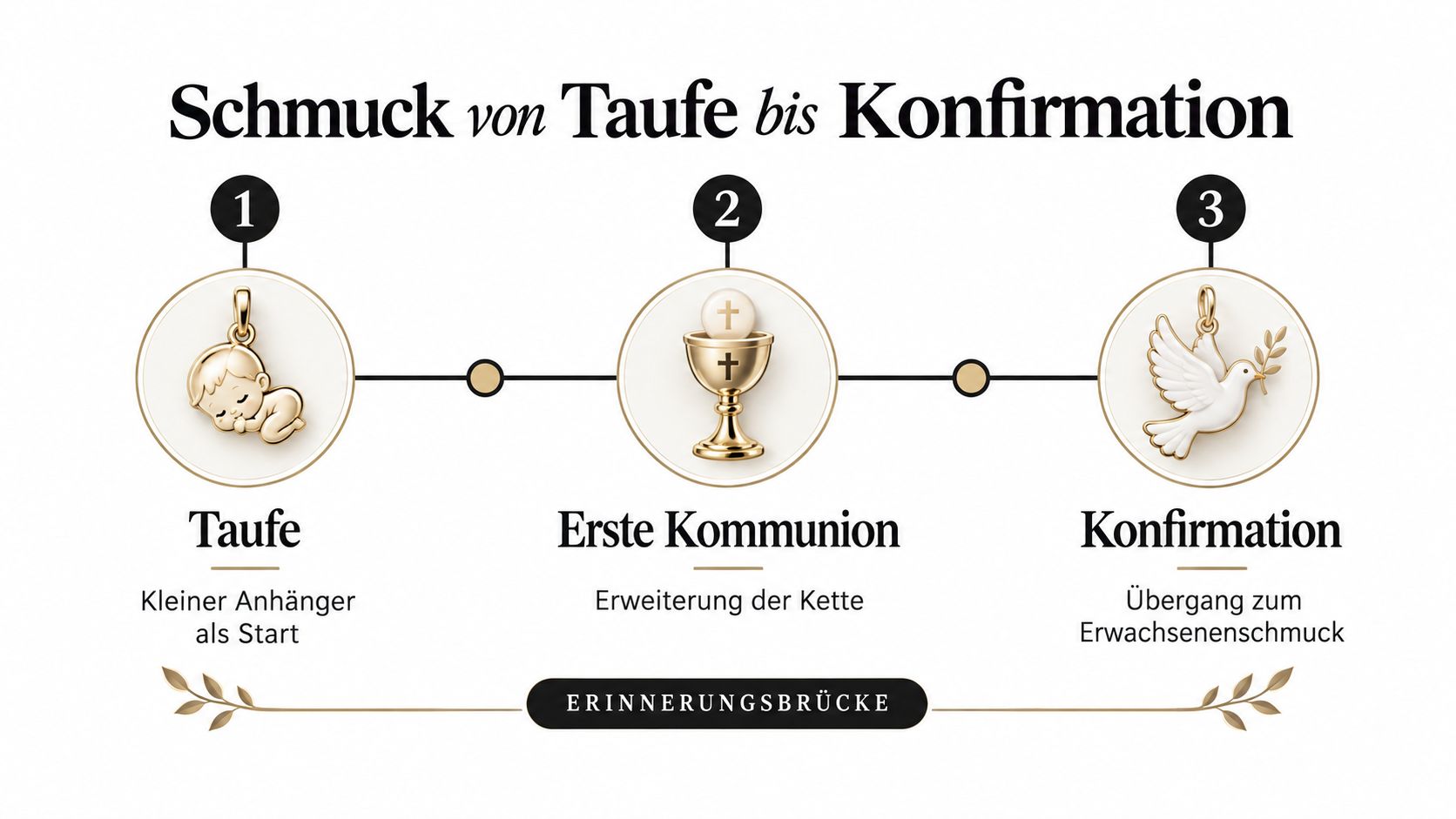
A baptism gift does not have to disappear into a drawer. It can be the beginning of a memory bridge that develops with the child. A small pendant is suitable for baptism, and later a separate necklace can be added for First Communion. For Confirmation, the style can then continue toward more mature jewelry.
A story in several pieces of jewelry
The first pendant can bear the name and baptism date. For First Communion, a complementary symbol such as a cross or chalice is suitable. For Confirmation, a new pendant with a confirmation verse or a dove can be added.
A change of material is also possible. A simple silver piece remains as the origin of the story, while a gold-plated version or a pendant made of 585 gold can be chosen for Confirmation. What matters is that the shape, symbolism, or engraving retains a recognizable connection.
The same basic principles apply to girls and boys. The choice should be guided by personality, safety, skin compatibility, and suitability for wearing later, not by rigid gender stereotypes. Ideas for First Communion jewelry for girls can also serve as a starting point for a gender-neutral family story.
The compact decision checklist
- Clarify the occasion: Should the piece only be presented or briefly worn on the day of the baptism?
- Choose a symbol: Does a cross, fish, tree of life, angel, or anchor suit the family?
- Check the material: Are the alloy, coating, and areas that come into contact with the skin clearly specified?
- Plan the engraving: Will the name and date remain legible without overcrowding the surface?
- Put safety first: No necklace while sleeping, playing, crawling, or wearing it unsupervised.
- Think ahead: Could the pendant take on meaning again later for First Communion or Confirmation?
- Secure storage: Do the box, care instructions, and personal card form part of the handover?
This creates a gift that does not depend on its momentary sparkle. It becomes part of the family history, waits safely for the right moment, and later reminds the recipient who thought of the child on this important day.
OTANTO offers handcrafted, customizable jewelry with name, date, and text engravings, as well as gift packaging for special occasions. If you are looking for an engraved pendant or a matching keepsake for a baptism, visit OTANTO and choose a piece of jewelry that combines symbolism, personal meaning, and safe storage for later.


